Enterprise website maintenance is a structured, SLA-based service for organizations operating complex websites, multi-site portfolios, or mission-critical web properties. Unlike general website upkeep, it addresses the operational, security, and governance requirements that come with managing web infrastructure at scale. The result is predictable service standards, defined response commitments, and transparent reporting that give internal stakeholders a reliable basis for decision-making.
What Enterprise Website Maintenance Entails
Enterprise website maintenance covers the ongoing activities required to keep complex websites secure, available, and functioning correctly. This includes routine updates to core systems, plugins, and themes; continuous security and uptime monitoring; structured incident response; controlled deployment processes; and regular stakeholder reporting.
For organizations managing multiple websites or large-scale web infrastructures, maintenance cannot be treated as an ad hoc activity. Uncoordinated updates, delayed security patches, or unmanaged incidents can affect user experience, operational continuity, and organizational reputation. A structured maintenance service provides the consistency and accountability that enterprise environments require. Organizations with smaller or less complex websites may find our general web maintenance services a more appropriate fit.
SLA-Based Maintenance and Service Guarantees
A service level agreement (SLA) is a formal commitment that defines the standards, response times, and quality expectations governing a maintenance relationship. In enterprise website maintenance, SLAs establish the foundation for accountability: they specify how quickly issues will be acknowledged and resolved, what activities fall within the maintenance scope, and how performance will be measured and reported.
For enterprise risk management, this structure matters because it removes ambiguity. Operations and IT leadership can plan around defined service parameters, and there is a documented basis for reviewing service quality over time. When website availability or security is tied to business operations, defined service commitments reduce exposure to prolonged downtime or unresolved incidents. SLA-based maintenance also supports internal governance by providing documentation that compliance teams can reference when auditing vendor relationships.
Security and Uptime Monitoring
Proactive monitoring is a core component of enterprise website maintenance. Security monitoring involves continuously scanning for vulnerabilities, unauthorized access attempts, malware, and configuration issues that could compromise a website or expose sensitive data. Addressing these threats early reduces the risk of incidents that disrupt operations or damage organizational credibility.
Uptime monitoring tracks website availability in real time, alerting maintenance teams when a site becomes unreachable or degrades in performance. For enterprise organizations, even brief periods of unavailability can affect customers, partners, and internal users. Continuous monitoring enables faster detection and response, limiting the business impact of availability issues. Organizations managing accessibility compliance alongside maintenance may also benefit from website accessibility remediation services as a complementary consideration.
Support for Complex and Multi-Site Environments
Managing a single enterprise website presents real operational challenges. Managing multiple websites across different domains, platforms, or regions compounds those challenges considerably. Each site may carry its own update schedule, security profile, performance requirements, and stakeholder expectations. Without coordinated maintenance, inconsistencies accumulate and risks multiply.
Enterprise maintenance services are structured to handle this complexity. Coordinated update management ensures that changes are applied consistently and tested appropriately across all properties. Centralized monitoring provides visibility across the entire web portfolio rather than requiring separate oversight for each site. This approach is particularly relevant for organizations whose web presence spans multiple brands, regions, or product lines.
For organizations whose web infrastructure requires ongoing development alongside maintenance, our web development services for complex websites and custom software development for enterprise integration provide complementary support. Organizations with mobile digital properties may also find value in our mobile app development complementing enterprise websites.
Incident Management and Maintenance Reporting
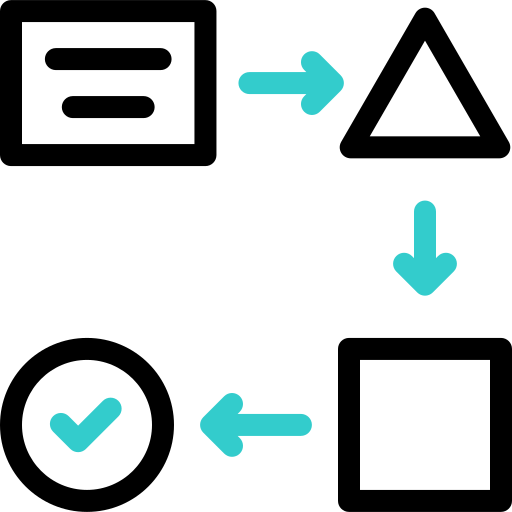
Incident management in website maintenance is the structured process of detecting, classifying, responding to, and documenting issues that affect website availability, security, or functionality. A defined workflow ensures that problems are handled consistently, escalated appropriately, and resolved within agreed timeframes rather than addressed informally.
Maintenance reporting provides the transparency that enterprise stakeholders require. Regular reports covering incident summaries, uptime metrics, update activity, and security status give operations and IT leadership a clear view of website health over time. This documentation supports internal accountability, informs budget and resource decisions, and provides an audit trail for governance purposes. Organizations conducting periodic quality reviews may also find value in an SEO audit for website quality assurance as part of a broader maintenance review cycle.
Controlled Deployments and Staging Workflows
Applying updates directly to a live enterprise website without prior testing introduces unnecessary risk. Controlled deployments address this through a structured release process in which changes are prepared, reviewed, and validated before being applied to the production environment. Staging workflows support this by providing a separate environment that mirrors the live site, allowing updates to be tested under realistic conditions.
For enterprise websites, where a failed update can affect thousands of users or disrupt business-critical processes, staging and controlled deployment practices are standard risk management measures. They reduce the likelihood of errors reaching production, provide a rollback path when issues are identified, and give stakeholders confidence that changes have been properly validated. This approach aligns with established web development best practices for managing complex website environments.
Pricing Models and Package Options
Enterprise website maintenance services are typically structured around tiered packages or custom service levels aligned with SLA commitments. Pricing generally reflects the scope of the engagement, including the number of websites covered, the complexity of the environment, monitoring requirements, and the response time commitments defined in the SLA.
Because enterprise maintenance needs vary considerably between organizations, pricing is best discussed through a direct consultation. We provide custom quotes based on your specific environment and requirements. Contact us to discuss your needs and receive a proposal aligned with your operational context.
Automation Tools in Enterprise Website Maintenance
Automation plays a practical role in enterprise website maintenance by handling routine tasks that would otherwise require significant manual effort. Automated monitoring, scheduled update checks, and alert systems reduce the time between issue detection and response, and lower the risk of human error in repetitive maintenance activities.
The specific tools used in any maintenance engagement depend on the technical environment and the requirements of the organization. The value of automation lies in the operational consistency and efficiency it enables across complex or multi-site environments, not in any particular platform.
Comparison with Basic or SME Website Maintenance
Enterprise website maintenance differs from general or SME-level maintenance primarily in scale, complexity, and the formality of service commitments. Smaller-scale maintenance typically covers a single website with straightforward update and monitoring needs, often without formal SLA structures or multi-site coordination requirements.
Enterprise maintenance introduces SLA-based accountability, structured incident management, coordinated multi-site support, and detailed reporting as standard components rather than optional additions. Organizations that do not yet require enterprise-level maintenance can find appropriate support through our general web maintenance services. For organizations operating e-commerce platforms with specialized maintenance requirements, specialized e-commerce website maintenance addresses those distinct needs separately.